
Talking Dirty (Money)
A fireside chat at the Royal Society for the Arts

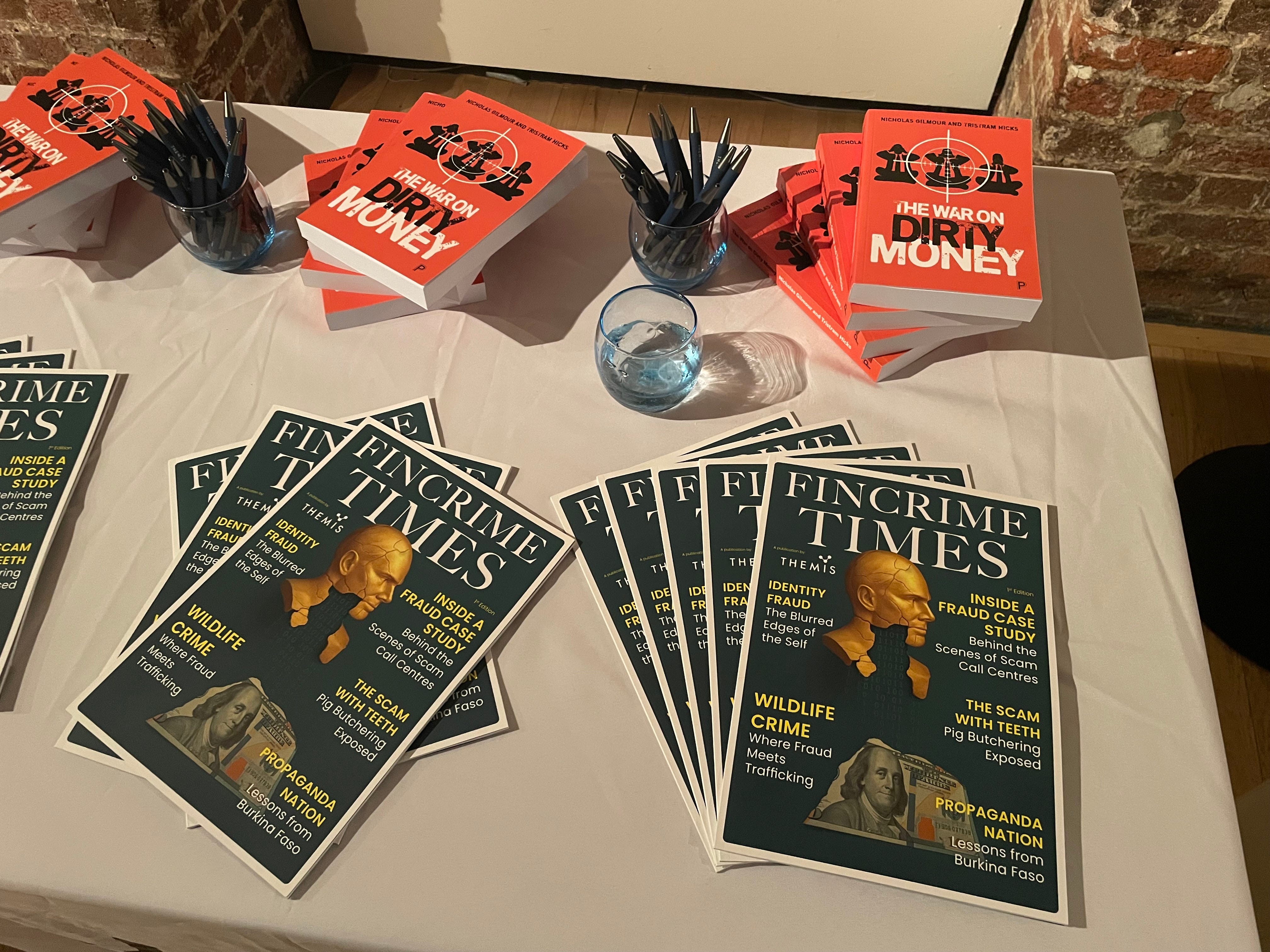
Themis “Fincrime Times” and Gilmour & Hicks “The War on Dirty Money”
On the stage at the auditorium in John Adam Street last week I was quizzed by Nadia O’Shaughnessy from Themis about my book ‘The War on Dirty Money’. There was standing room only for audience of 130 plus and some great audience questions. I had a script, to some of which I actuallly stuck. Here is what I intended to say!
Nadia: Your book is called “The War on Dirty Money” – but you argue we’re actually losing this war, or at least fighting it completely wrong. Many in the audience won’t have read the book yet, so I’d love it if you could kick us off with a quick summary of its central premise.
Tristram: The central premise of the book is that the War on Dirty Money hasn’t really started and if it has it’s not a global war but about 200 skirmishes in the 200 jurisdictions that exist around the world. One of these skirmishes went really well, the one in the UK. It is a classic ‘Before and After’ that is recent enough to be relevant and long enough ago to get the data to understand what happened
The book is based on our experience [along with my co-author Dr Nick Gilmour] of the UK for 15 years and then on 15 years of consultancy around the world - thirty years of practical experience each. Lots of people write about problems in financial crime but this is a book of solutions. there is a ‘solutions box’ at the end of each chapter. They are a basis for discussion, to change the narrative from despair to practical opportunity based on evidence.
Nadia: You wrote the book after a wealth of experience at the coal face, fighting financial crime as a New Scotland Yard detective superintendent and international criminal justice advisor. What did you see that made you realise we needed a completely different approach?
Tristram: I want to talk about the amazing Proceeds of Crime Act (POCA). In the olden days, by which I mean before 2003, convicted criminals in the UK kept the money of which they had been convicted. Financial investigations were never commenced because no-one asked for them to be done and the law was ineffective. Hardly anyone convicted in a criminal court lost money, there were a few dozens of cases involving a total of £15 million, on average, in the decade before POCA. That total, by the way, is all agencies put together.
Asset recovery from criminals is the antidote to Dirty Money. It deters future offending, is disables current criminal activity, it can compensate individual victims and communities blighted by crime. It works against all kinds of crime - environmental, corruption, trafficking of all kinds, modern slavery. All forty of the predicate crimes listed by the Financial Action Task Force - the global standard-setter of which the UK is a founder member.
Law enforcement has a key role but there are many law enforcement agencies and they’re not all the same. Before POCA the primary asset recovery agency doing more asset recovery than all the others put together, was the Customs Service. Then, in order, the National Crime Squad the Serious Fraud Office, the City of London police, the rest of the police forces and the Revenue Service. The Revenue Service tends to make tax demands rather than criminal confiscation but they do do some.
After POCA the agencies changed; the primary agency by a huge margin - 60% - was the ‘rest of the police’ and while the national agencies improved their productivity markedly, because of the powers in the POCA, the police were far away the biggest performers, causing tens of thousands of people to lose hundreds of millions of pounds. Officers and managers working in asset recovery had very different experiences, depending which agency they were in. For the national agencies it was a game-changer, their productivity doubled or tripled. For the police it was an entirely new game, their productivity went up by twenty or thirty times, they discovered an entirely new approach to all kinds of crime, I will give some examples later.
The reason for this is ‘parallel investigation’, the new concept of criminal and financial investigators working side by side creating a important gearing affect that multiplies the efficacy of both. The Police are on the frontline of crime and therefore have many more crime investigations. Indeed, the only constraint on the number of potential financial investigations is the number of criminal ones.
Nadia: Before we go further, I wanted to pause to reflect a bit about why this all matters, especially for the benefit of those in the room who don’t work in financial crime. In the past, you’ve made a “straightforward link” between corruption, dirty money and the loss of life in disasters like the Turkish earthquake, where building standards were compromised. Can you walk us through how money laundering and corruption create real-world tragedies like this?
Tristram: We mentioned the Turkish case in the book but there are many many other examples elsewhere. In Turkey poor building standards meant that buildings were poorly constructed and when an earthquake struck hundreds of people died unnecessarily because corrupt payments weakened the buildings so that they were death traps. There are other man-made catastrophes: the destruction tropical rain forests, the use of counterfeit medicines in West Africa - a United Nations report in 2023 found that half a million people die a year because they’re taking malaria medicine and childhood pneumonia medicine that doesn’t work. They believe it will save them and it doesn’t because of corrupt payments to officials.
These crimes are committed by companies which are effectively immune from prosecution because of the protected status of companies in law. They are legal people with rights but their responsibilities are, in practice, beyond the criminal law to address.
Nadia: So clearly this shadow economy is causing huge harm. And yet you argue that both the public and private sector response is vastly inadequate. Let’s start with the public sector side. You’ve written that policymakers are inadvertently facilitating tax evasion, corruption and organised crime by ‘separating crime from its root cause’ - the money itself. What do you mean by that?
Tristram: We have a very fractured system which is very vulnerable to silo thinking. Between these Silos the criminals make their money. We separate crime from the proceeds of crime and the result of that policy, is agencies to address crime are separated from agencies that address the Proceeds of Crime. We have a money laundering definition which is different for the private sector; which favours integration, layering and placement, from the definition used by the public sector, where money laundering is simply the handling of property derived from criminality. This means we’re not talking the same language. We separate crime from financial crime and I suggest that if you put the word ‘financial’ or ‘economic’ in front of the word ‘crime’ you weaken the meaning, you make it sound academic, you make it sound boring, you separate the harm of crime by putting that kind of word in front of it. We separate our anti-money laundering prevention effort, our compliance industry; from our anti-money laundering enforcement effort, our criminal justice system.
Nadia: And can you then walk us through a real case where “follow the money” completely changed the outcome of an investigation compared to “follow the criminal”?
Tristram: There are so many cases! The main reason that a financial investigation fails - worldwide - is because it never starts. There is no pressure from the management of law enforcement, But in the UK police we put Accredited Financial Investigation team in police stations and that created opportunities that were found by highly skilled and dedicated financial investigators working in a police environment.
For example, police executed a drugs warrant in South London. There were lots of police there because it was feared there might be potential violence and the police entered the house which was on several floors. They made the place safe, searched for drugs but they didn’t find any, so they were all leaving to go back to the police station for a cup of tea. Then the Accredited Financial Investigator takes over. He’s been walking the building looking for cash and documents related to drug dealing but instead he sees a photocopier and blank plastic cards and inks and other paraphernalia that he doesn’t quite understand so he stops everyone leaving while he works out that what he’s walked into. What he has found was the UK’s biggest fake identity factory. That’s the value of a highly trained financial investigator on the Frontline.
A second example is a disorderly pub. There are offences taking place in the streets nearby this pub, there are lots of calls about the noise. There are victims coming to the police. The Borough Commander gets lots of public disquiet in relation to the premises so he tries the traditional techniques: high visibility patrols, surveillance, even undercover officers to look for drug dealing. None of it works and the weeks go by. Then he’s walking past the Payback Unit and he asks them if they can take a look, by then of course there’s a lot of intelligence about the clientele, so they put the details through financial routine checks and it lights up like a Christmas tree. It turns out that there are many directors of import/ export companies, paid recipients of documents to their addresses. There are funds missing that relate to the people who frequent the pub and their companies. The Payback Unit of Accredited Financial Investigators then begin multiple financial investigations into VAT carousel fraud and other frauds. The landlady herself is convicted of mortgage fraud. All of this arises from the Frontline against crime but is being solved by having Accredited Financial Investigators on the Frontline.
Nadia: On the private sector side, you’ve written that, and I quote: “as a rule of thumb, the regulated sector is not paying staff to prevent money laundering... the focus of most is on keeping the AML regulator at bay.” And we’re talking about vast sums of money here – you estimate that over 200 billion dollars are spent annually on anti-money laundering compliance in the financial sector. What needs to change if the private sector is to have a real impact on dirty money flows?
Tristram: The private sector is just not getting justice from the public sector and I think we should all demand more transparency from the authorities. The money that’s paid in fines for compliance failures, the money that’s recovered from criminal confiscations based on financial intelligence provided by the private sector, where does that money go? Can we be more transparent about how it is spent to benefit society? Are we reinvesting in our financial investigators to make the public cake bigger?
In the meantime the private sector has to defend itself by normalising due diligence, by raising professional standards and by doing checks on who we’re doing business with. But there’s more that we could do in the field of asset recovery and my feeling is that civil society - the private sector - has a role to ask how their efforts are contributing to the fight against crime.
In the 10 years following the process of crime act in 2003 there was an implementation committee composed of public sector agencies which steered and implemented the new concepts. The new professional skills and training resulted in 10 record-breaking years of asset recovery. That’s about understanding how the agencies fit together and how they work together. The cement that worked was the new profession of Accredited Financial Investigator, drawn from all the agencies, trained together in mixed groups, with mixed mentoring and a single centre of excellence. The AFIs were the ones who did the work, who made this happen. We could do better. What we should’ve done was ensure that all AFI have the same terms and conditions across agencies. We should have sold the concept internationally so that we have AFI’s in France and South Africa and all over the world who will talk to each other across borders to ease that most difficult thing International corporation. We should’ve created a career path so that managers of financial investigators know what these people can do and finally I think there is potential to extend the public sector AFI profession into the private sector to create a two way door between these two parts. Many people want to work in the public centre because the nature of the work is more interesting, but working on both sides seems to be the ideal.
Nadia: So, if you were to give a 21-year-old who is entering the AML field one piece of advice today - what would make them world class in 5 years?
Tristram: I am a believer in expertise and that comes from education, for example, the university subject of Crime Science which is perhaps more relevant than criminology for this kind of work. The public sector role of police analyst is an excellent way to understand the criminal world seen from that perspective so I would encourage a young person to get a solid grounding in the real world and build up their expertise in a real environment like a police station or other law-enforcement agency as near to the Frontline as possible to understand better the origins of the data that would be relevant to a financial analyst addressing financial crime.
Nadia: So that’s inside the system... but what about outside the system? We’ve talked about what banks, law enforcement agencies, FIUs, the FATF etc are and aren’t doing, but this shadow economy isn’t just an industry problem - it affects democracy, health and prosperity - i.e. us all. So, for the non-AML people in the room tonight - the people who never file SARs, don’t do typologies, don’t read FATF mutual evaluations - what can they actually do?
Tristram: There is a trust deficit in our society, enhanced by fake news, fake identities and new technology. We all need to, in our private and professional lives, be more professional to normalise due diligence so that it’s not an extra tick box that provides no real security but it’s a real concept that we use to make sure we ask fair questions of the people were dealing with. We accept intrusion to board a plane, less intrusion to board a bus, but you should still have a ticket. You need diligence to borrow a book and ironically rather less due diligence to form a company, although after many years that due diligence is set to increase this year. But a professional person does checks, we shouldn’t rely too much on natural assumptions and hunches.
Nadia: You spent time in the trenches as a detective, then became an advisor to governments worldwide, and now you’re writing and campaigning for reform. Looking back over that journey - what still keeps you fighting this fight and believing the system can change?
Tristram: I experienced change. The Proceeds of Crime Act fundamentally changed our ability to confiscate assets at scale so that ‘volume’ or ‘petty’ crime no longer paid. As mountains of cash came in the crime rate fell off a cliff. To be sure there were other factors, but to me there seems to be an obvious cause and effect.
Personally after fifteen years watching crime grow in the 1980s and 1990s I saw it fall dramatically. At the time, in the police, the Prosecution Service and in the Home Office there was a sense of victory. It is a great feeling and I am sure we could do it again.
What troubles me is that, since those early years of triumphant success, we have somehow created a dominant narrative of failure. I think we could reverse this narrative and that is why I wrote a book of solutions and why I am here tonight talking to this influential audience. Thank you for the opportunity.
***
After the discussion I signed some books which Themis had kindly purchased for their guests. My sincere thanks to Dickon Johnstone and Lizzie Stewart of Themis and to all of their enthusiastic and engaged staff.
Hi Tris, that sounds like a great event, wish I could have been there. Nadia seemed like a very well informed and intelligent interlocutor. As you know, we share all of the opinions, frustrations and wish-lists expressed therein, and I would have loved to collaborate with you and Nick on this project. I've really missed all this since my incapacity, please keep me informed of any further initiatives that come your way. Very enjoyable read. Well played.